
Mass Plywood
Panels
What Is a Mass Plywood Panel?
A Mass Plywood Panel (MPP) is a large-format, veneer-based mass timber panel — an engineered wood product built up from layers of structural wood veneer (rather than the solid lumber used in cross-laminated timber).
The veneers are graded, glued, and pressed into thick structural panels used for floors, roofs, walls, and other structural elements. MPP is APA-certified under the ANSI/APA PRG 320 mass timber standard, giving it the code recognition mass timber projects require.
Mass Plywood Panel vs.
Cross-Laminated Timber
Both are large-format mass timber panels, but they're built differently.
MPP's veneer construction delivers distinct efficiency advantages.
Mass Plywood Panel (MPP)
Built from
Layers of structural wood veneer (veneer-based).
Material efficiency
Uses ~20% less wood for comparable performance.
Log source
Can use small-diameter timber (as small as ~5″).
Weight
Lighter than lumber-based CLT, as strong or stronger.
Certification
APA-certified under ANSI/APA PRG 320.
Cross-Laminated Timber (CLT)
Built from
Layers of solid sawn boards (lumber-based).
Material efficiency
Uses more solid-lumber fiber.
Log source
Requires larger, higher-grade lumber.
Weight
Heavier per equivalent panel.
Certification
Certified under ANSI/APA PRG 320.
Built from
Layers of structural wood veneer (veneer-based).
Material efficiency
Uses ~20% less wood for comparable performance.
Log source
Can use small-diameter timber (as small as ~5″).
Weight
Lighter than lumber-based CLT, as strong or stronger.
Certification
APA-certified under ANSI/APA PRG 320.
Built from
Variable — depends on species, grade, and natural defects.
Material efficiency
Shrinks, warps, and crowns as moisture changes seasonally.
Log source
Limited by lumber length/grade; typically 20–24 ft max.
Weight
Heavy in deeper sizes; more labor.
Certification
Solid section wastes material where demand is lowest.
Why Spec Mass Plywood Panels?
MPP fits projects that need structural efficiency, prefabricated precision, and versatility across building types — and RedBuilt adds a system-minded partner who coordinates the panels with the whole structure. When you spec RedBuilt, you get:
Project-specific design support
For floor, roof, and wall applications, coordinated to your structure.
Delivery coordination
Sequencing support so panels arrive aligned with the installation schedule.
System integration
MPP that works alongside CLT, glulam, steel, and hybrid systems as part of a broader design strategy.
Prefabricated precision
Panels manufactured with coordinated openings, dimensions, and connections to cut field labor and rework.
Support through installation
Technical guidance from product selection and layout through connections and field sequencing.
Benefits
Material efficiency
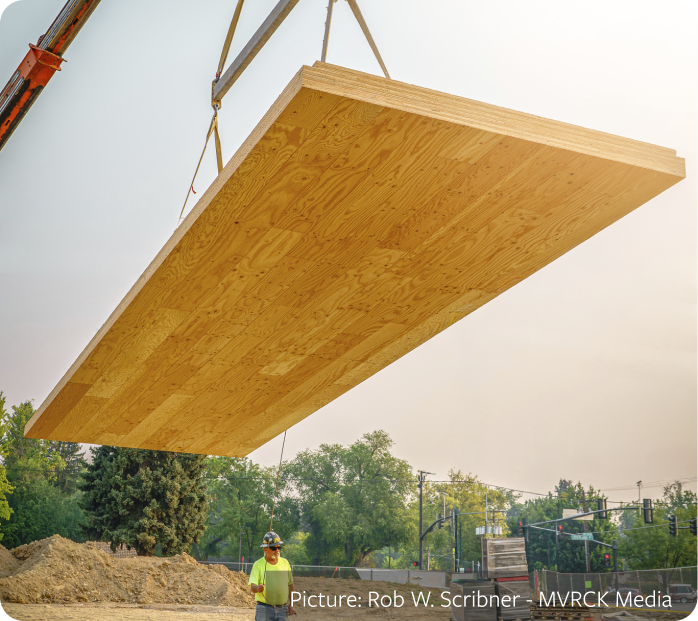
Veneer construction delivers comparable performance from roughly 20% less wood than CLT, using smaller-diameter logs.
Large-format panels
Big panels cover floors, roofs, and walls fast, reducing pieces and connections.
Strong and lightweight
High structural performance at lower weight than lumber-based CLT — easier handling and lower structural demand.
Prefabricated precision
Coordinated openings and dimensions reduce field cutting and simplify installation.
Design flexibility
One product serves floors, roofs, walls, and other structural elements across building types.
System integration
Works with CLT, glulam, steel, and hybrid structures.
Applications — Floors, Roofs & Walls
MPP is not limited to one use — its versatility is a core advantage:
Floors
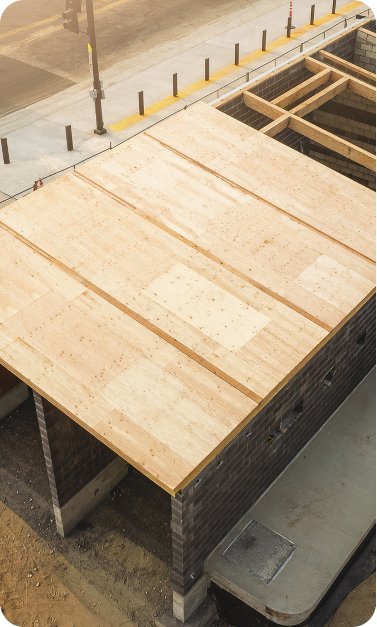
Large-format floor panels that install quickly and reduce supporting-structure complex.
Roofs
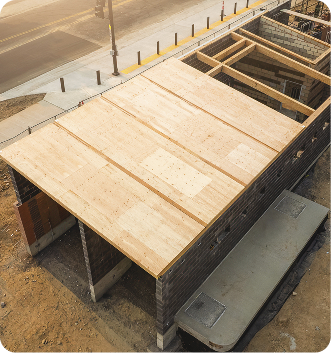
Strong, efficient roof panels supporting clean spans and coordinated structural design.
Walls & shear walls
Structural wall panels where precision, strength, and manufacturing consistency matter.
Other structural elements
MPP can serve additional structural roles within a mass timber or hybrid system.
Sizes & Specs
MPP is produced in large formats and a range of thicknesses to suit floor, roof, and wall applications:
Thickness
Available in 1-inch increments across a wide range (the APA-certified MPP product spans roughly 2″ to 12″).
Panel size
Large-format panels (the certified product reaches up to about 11′-10″ wide × 48′ long).
Engineered to project
RedBuilt sizes and coordinates panels to your spans, loads, and openings.
MPP is one of the most resource-efficient mass timber products. Its veneer construction delivers comparable strength from less wood and can use small-diameter, fast-growing, or lower-value logs — extending the wood resource.
As a mass timber product it stores biogenic carbon for the life of the building and carries substantially lower embodied carbon than steel or concrete, documentable via Environmental Product Declarations (EPDs) and supported by FSC/SFI-certified sourcing.
Fire & Code Compliance
Mass timber panels char at a predictable rate, forming an insulating layer that protects the structural core — which is why exposed mass timber can be fire-rated by calculation.
The 2021 IBC established three mass timber construction types — Type IV-A (up to 18 stories, protected), IV-B (up to 12 stories, limited exposed timber), and IV-C (up to 9 stories, exposed with a 2-hour rating) — plus Type IV-HT.
MPP’s APA certification under ANSI/APA PRG 320 supports its use in these code paths.
Designing with Mass Plywood Panel
Mass Plywood Panel (MPP) is a digital-fabrication product, designed in the model and CNC-cut for precise fit. RedBuilt helps you specify and integrate MPP into your project, coordinating it with the broader structural system.
For full product data and technical resources, visit the manufacturer, Freres Engineered Wood.
Building Types
MPP suits a wide range of projects where speed, strength, and design flexibility matter:
Commercial buildings
Educational and institutional facilities
Industrial and specialty structures
Mixed-use developments
Mass timber and hybrid buildings
Ready to Spec Mass Plywood Panels?
Our in-market technical sales team is ready to assist with selection, sizes and spans, connections, system integration, and support from design through installation.